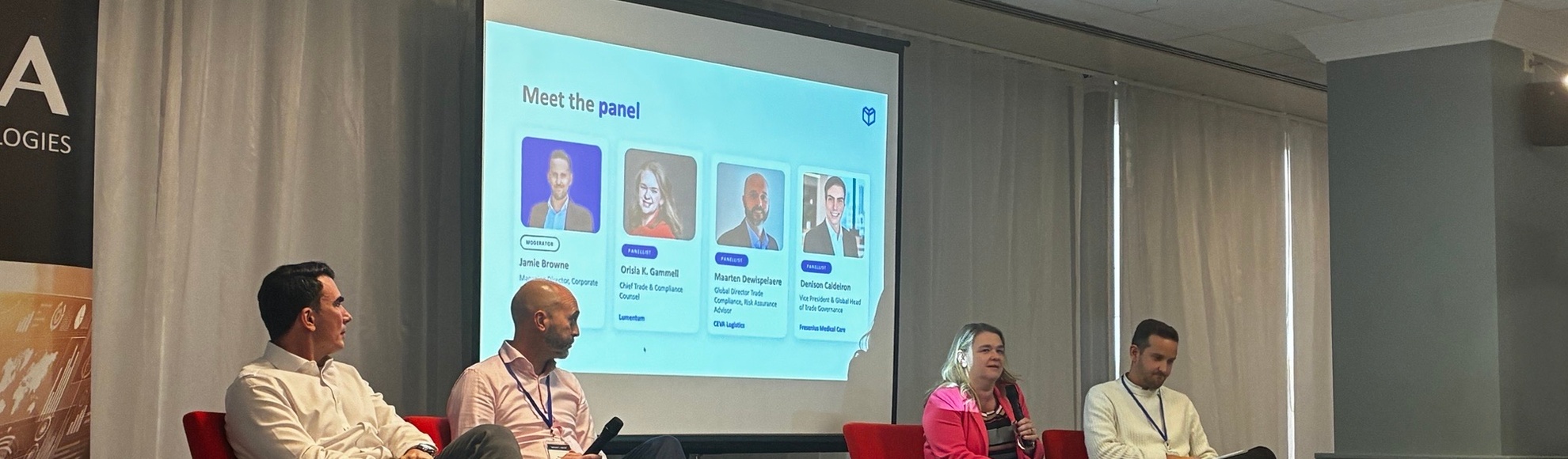
Ask a room full of trade and export compliance professionals where their function reports, and you might expect a lively split. At NielsonSmith's Sanctions and Export Compliance conference in London this week, there wasn't much of one.
Jamie Browne moderated a panel on the future role of trade compliance and opened with a show of hands. Nine out of ten people said their function reports into Legal. Only one said supply chain. When Jamie followed up by asking whether trade compliance was sitting in the right place, almost nobody disagreed.
It was one of those moments where a room tells you something a survey can only hint at.
A shift that has been building for years
The direction of travel isn't new. Our own data shows trade compliance reporting into Legal rose from 38% in 2017 to 51% in 2025. Over the same period, the share reporting into supply chain fell from 48% to 38%.
What stood out in London was the extent of it. A near-unanimous show of hands suggests that, for this group at least, the long-running debate about where trade compliance should sit is largely finished. Sanctions regimes that change at short notice, export controls tightening around technology, and the personal exposure that comes with getting it wrong have all pulled the function closer to the lawyers.
Which leaves a more interesting question on the table. Now that trade compliance has landed in Legal, what is it actually being asked to do?
Same reporting line, very different jobs
The panel answered that question better than any org chart could. Orisia K. Gammell, Maarten Dewispelaere and Denison Caldeiron all sit within Legal, and all three do a visibly different job.
One holds a chief-level counsel role inside a hardware manufacturer. Another is a non-lawyer running trade compliance and risk assurance for a logistics business. The third is Head of Trade Governance in a global legal function.
If you only looked at the reporting line, you would assume these were broadly the same role. They aren't. The scope, the stakeholders and the skills each one leans on vary considerably, and that variation matters far more to a hiring manager than the box on the chart.
What's in a name?
The part of the discussion that stuck with Jamie came when Denison and Orisia compared what their functions are actually called.
Orisia's team is Global Trade. Denison's is Trade Governance. Maarten's still says Trade Compliance.
For Orisia and Denison, the choice is deliberate. Global Trade reads as a business partner. Trade Governance reads as helping the business govern how it trades. Both are steering away from what people tend to assume when the word compliance turns up in an email subject line: a brake, a sign-off, a reason to wait.
It's a small detail, but in our experience these details are often the first visible sign that a function has changed its ambitions. Teams rarely rename themselves for the sake of it. They do it because they want to be invited into conversations earlier, and they've realised the old label was keeping them at the end of the queue.
The role is moving faster than the job description
The clearest takeaway from the week was that the role is changing faster than the org chart, and faster again than the job spec.
That gap is where a lot of hiring into trade teams goes wrong. Someone leaves, the old specification gets dusted off, and the business ends up recruiting for the role it had five years ago. The reporting line may have moved to Legal, the team may now call itself Global Trade, and the board may expect it to advise on market entry, but the advert still reads like a classification and licensing role.
The result is predictable. Strong candidates who see themselves as business partners don't recognise the job, and the people who do apply are a good fit for a function that no longer exists.
Getting it right going into 2027
If you're building or reshaping a trade function over the coming year, a few questions are worth asking before anything goes to market:
- What do you want the function to be known for in two years' time, and does the title reflect that?
- Which decisions should trade sit inside, rather than review after the fact?
- Does the role need a qualified lawyer, or someone with deep operational and regulatory experience who can work alongside Legal?
- Would your current job description attract the person you actually need, or the person you hired last time?
The reporting line debate may be settling. The harder work of defining what a modern trade function looks like, and finding the people who can lead it, is just getting started. It's what we spend our working lives on.
Our thanks to Orisia, Maarten and Denison for their time and candour, to NielsonSmith for hosting, and to Philip Redhead and Adam Nelson, who were on the Leonid stand across both days and between them had many great conversations.